Designing Google Reader's trends
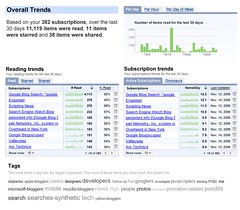
I've been on vacation for a few weeks, but I had a nice surprise waiting for me when I got home: the first example of our design work at Google has publicly launched.
Last month, we spent some time working with the Google Reader team on an new feature they'd been developing. As a hosted application, they've got lots of data about what people are reading and how often blogs get updated. Wouldn't it be interesting, they suggested, if you could visualize your reading behavior and see how it matched up with publisher's behavior. Since we have some experience with data visualization, we jumped at the chance to do a 20% project.
The result is a set of charts and graphs that attempt to help people not only understand how they interact with content, but let them act on it as well. Turns out this is a great interface for pruning away feeds that you've either lost interest in or are no longer being updated.
But beyond the visualization, this serves as a good example of collecting and understanding the ambient information that flows through our digital lives. I've been fascinated by this for a while, but started thinking about it more last year when Tom Coates posted on the topic. As we move through our connected days, the thousands of tiny behaviors can be recorded and analyzed, helping us to better understand who we really are, be it through the music we listen to, the sites we bookmark, or the money we spend.
It makes me want more! Places I go, people I meet, energy usage, calorie consumption, heart rate -- just imagine all the streams of data we can record and review and learn from. But for now, I'll settle for the feeds I read.
For more on the feature, see Mihai's post on the Reader blog. If you have a Reader account, you can view your trends here. If not, have a look at this screenshot.
This entry was written by Jeffrey Veen and posted 9 January 2007 at 9:18 PM. It was filed under Personal, Web Design. | View blog reactions
There are some interesting comments about Trends on Matt Cutts blog at http://www.mattcutts.com/blog/new-reader-trends-page/, not least the sense of "so how many feeds/posts do YOU consume?"
Not that that kind of thing matter to me, you udnderstand ...
In any case you've done t'riffic job - again.
Sound really great, well i keep a track of the trends of my technical blog.
At Jaiku, we are heading towards the vision of putting together one's "lifestream", that is, a feed of different types of actions/events that happen in one's online or physical life. The latter data (e.g. rough location, nearby friends) is currently extracted from mobile handsets, and online events are from feeds of various services such as Flickr, blogs, Last.fm, Twitter, etc.
The question for us is how the users want to use and share this information, that is, how can Jaiku add significant value to it. At the moment we have enabled commenting, which is a small step towards releasing the full potential of the concept.
(While I was typing this, my co-worker noticed you are one of our so called passive members :-)
Wondering why the sparklines did not make it. I have been finding with a tiny bit of education (this is what this is) regular people find them quite helpful.
Hi Jeff --
This notion of tapping in to all of these various streams reminded me of an interesting device, developed through Microsoft research, that would "outsource your memory." The device was a constant audio and video recorder worn around your neck. Everything you said was recorded, and a wide-angle photograph was taken every five minutes. You could then browse all the collected information. Forget what your girlfriend told you last week? Just look it up.
Of course, as with many potentially useful concepts, it raises some hefty privacy concerns. Pretty interesting stuff. Here's the link:
http://research.microsoft.com/sendev/projects/sensecam/
By the way, I met you briefly over the summer when I was interning at Google, and I've just signed on to work there in the New York office as a ux designer.
Hi Jeff,
Great design work, thanks !
Some tips on your "not only understand how they interact with content, but let them act on it as well" statement:(I´ve posted this on the Google Reader group "suggestions" post as well:
http://groups-beta.google.com/group/Google-Labs-Reader/web/suggestions+for+google+reader)In Trends, at "Subscriptions trends, Inactive": This information is very usefull to remove no longer updated feeds.
I found however that after searching for the specific blog (to see what had happened to the subscription) that the subscription rss name, (or the blog location ánd the subscription rss name) were changed. And after specifiying the new subscription rss name in Google Reader I got all my missed items. Trends should either offer a search icon for inactive subscriptions, or take care of this directly and offer suggestions.
Blog search in combination with comparing ones feeds with users like them would do the trick.
Even when no suggestion can be made (because the blog no longer exists) this should be told and this also would be valuable information. This could be something a lot of users would appreciate (as in: how do YOU react when one of your favorite subscriptions dries up ?)Further, we need a better link to the trends page. It's only available on the home page (current one is especially unhandy when you've changed your start up from the standard home page to your favorite label/folder)
Cheers,
Peter Huesken
It was recently posted on the Extractable blog at there's a Periodic Table of Visualization Methods available. Check it out!
http://www.visual-literacy.org/periodic_table/periodic_table.html
Currently:
() More...
About Me
Bio: Jeffrey Veen
Book: "The Art & Science of Web Design"
Book: "HotWired Style: Principles For Building Smart Web Sites"
Work: My LinkedIn Profile
Travel: China, Tuscany, Kayaking in Baja, Touring Costa Rica, Studying Theater in London
Categories
» Business (6)
» Cycling (27)
» Information Architecture (15)
» Personal (80)
» Software (14)
» Technology (90)
» Travel (38)
» Web Design (96)
Popular Posts
» Making a Better Open Source CMS
» Seven Steps to Better Presentations
» A Contrast in Urban Design
» IA Jargon Watch
» On Writing Short
» Pain and Cycling
Recent Photos
XML Feeds
Subscribe to my site
Click the link above to be notified automatically every time I add a new post.
